Bitcoin halving is one of the most talked about events in the Bitcoin world. It happens roughly every four years and cuts the amount of new BTC created per block in half. For miners and investors, halvings are pivotal moments that can shift profitability, adjustment dynamics, and the broader market sentiment. At TheRealBitcoin.org we break down the concept in plain language, show how it actually works, and offer actionable tips to navigate the changes without panic. If you are new to mining or you want to better understand how halving fits into the larger Bitcoin economy, you are in the right place.
What is Bitcoin Halving
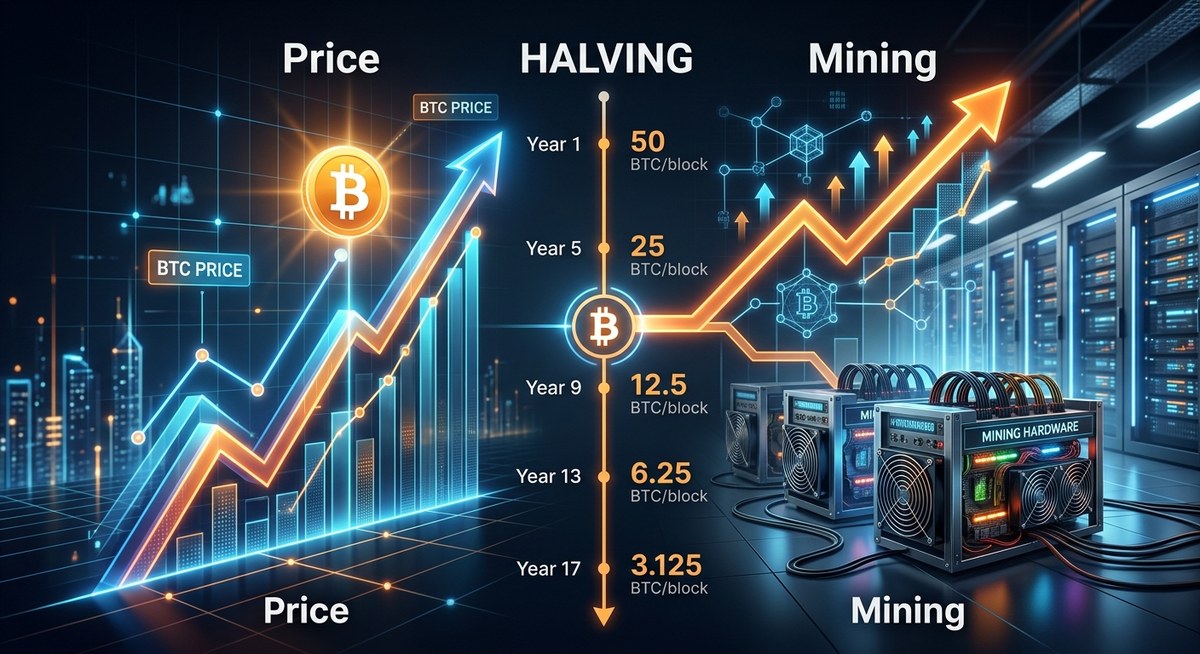
Bitcoin halving is a built in mechanism in the Bitcoin protocol that reduces the block reward miners receive by 50 percent every 210,000 blocks. This means fewer new bitcoins are minted over time, which gradually slows the rate at which the total supply increases. The design aims to mimic a predictable supply schedule and keep Bitcoin scarcity as a long term feature.
The reward mechanism
- At launch in 2009, the block reward was 50 BTC per block.
- The first halving in 2012 reduced the reward to 25 BTC per block.
- The second halving in 2016 reduced it to 12.5 BTC per block.
- The third halving in 2020 reduced it to 6.25 BTC per block.
- The most recent halving in 2024 brought the reward to 3.125 BTC per block.
- The pattern continues, with each halving halving the reward again at roughly four year intervals.
Why this design exists
- Controlled supply: The halvings slow the rate at which new BTC enters circulation.
- Inflation discipline: Each halving tightens the net new supply relative to demand.
- Long term economics: Over time, the reduced supply growth can influence price dynamics, mining competition, and investment decisions.
How Bitcoin Halving Works
A halving is not a price event or a market trick; it is a protocol event tied to block production. Bitcoin aims for an average block time of about 10 minutes, which yields roughly 6 blocks per hour and about 144 blocks per day. Every 210,000 blocks, the reward per block is cut in half.
The 210,000 block interval
- The interval is fixed, not based on time alone. With an average 10 minute block time, 210,000 blocks take about four years to reach.
- When the 210,000th block after a halving is mined, miners receive half the BTC per block going forward.
What stays constant and what changes
- Constant:
- Block time target around 10 minutes
- The total supply cap of 21 million BTC
- The governance of the mining reward schedule via protocol rules
- Changes:
- The amount of new BTC minted per block
- Miner revenue per block and per day
- The relative economics of mining operations as rewards shift
History of Halvings
Understanding halvings through history helps explain how the market and miners have reacted in the past.
The first halving in 2012
- Reward dropped from 50 BTC to 25 BTC per block.
- The event coincided with a period of growing interest in Bitcoin as a new digital asset.
- Long term price trajectories showed increased attention to Bitcoin, though immediate price moves varied.
The second halving in 2016
- Reward dropped from 25 BTC to 12.5 BTC per block.
- The mining landscape evolved with more efficient hardware and industrial scale operations entering the space.
- The market began to price in scarcity and infrastructure growth, contributing to a multi-year bull run culminating in late 2017.
The third halving in 2020
- Reward dropped from 12.5 BTC to 6.25 BTC per block.
- The event occurred during a time of macro uncertainty and global market volatility, yet Bitcoin moved into a pronounced bull cycle in 2020 and 2021.
- Miner economics faced higher energy costs and a competitive hardware upgrade cycle continued.
The fourth halving in 2024
- Reward dropped from 6.25 BTC to 3.125 BTC per block.
- This halving reinforced the ongoing shift toward more efficient mining equipment and cost controls in the industry.
- Price action around the halving has shown that many market participants watch for longer term supply dynamics as much as for short term price moves.
The next halving and expected timing
- Halvings occur approximately every four years, aligned with block production.
- The next halving is expected when the 210,000 block interval completes after the 2024 event, roughly in 2028.
- As always, exact timing depends on actual block production rates, which can vary modestly with network hash power.
Halving and Price Dynamics
Halving events are widely discussed in terms of price impact, but the relationship is nuanced.
The scarcity argument
- Halvings reduce the rate of new Bitcoin entering circulation, which can tighten supply if demand remains steady or grows.
- If demand does not drop, the reduced new supply can exert upward pressure on price over time.
Market psychology and expectations
- Traders and investors often price in the expectation of a halving long before it happens.
- A lot of price movement around halvings can reflect anticipation, profit taking, and shifting risk appetites rather than immediate halving effects.
Price volatility around halving events
- Historical halvings have been followed by significant price swings, but the direction and timing of moves vary.
- It is common to see price rallies or retracements both before and after the event as markets absorb the new supply dynamics.
Important caveats and long term trends
- Halving is a supply side event; price is influenced by many other factors including macroeconomics, regulation, adoption, exchange flows, and technology.
- Long term price trends depend on a mix of demand growth, network security, and the ongoing costs of mining.
Mining Economics and Halving
For miners, the halving directly affects revenue, which in turn influences profitability and strategic decisions.
Revenue implications
- Before halving, miners receive a certain BTC per block reward.
- After halving, the same amount of work yields half the number of BTC per block, assuming market price is unchanged.
- Revenue is a function of price times the miner’s share of total network production.
Costs and margins
- Electricity is often the largest operating expense for miners.
- Other costs include cooling, maintenance, facility costs, rent, and depreciation of hardware.
- Halving can compress margins if BTC price does not rise in step with the reduced block reward.
Hashrate and difficulty response
- If many miners stay in the market and profitability declines, some miners may shut down or upgrade to more efficient hardware.
- The Bitcoin network automatically adjusts difficulty roughly every two weeks to keep block times near 10 minutes, which can affect revenue per hash for continuing miners.
Equipment efficiency and investment decisions
- Halvings push miners to favor higher efficiency hardware to maintain profitability.
- Decisions around upgrading rigs, expanding capacity, or mothballing older equipment become common around halving cycles.
Small vs large miners
- Large scale miners often benefit from economies of scale, bulk hardware pricing, and better access to cheap electricity.
- Small miners may face tighter margins and higher per unit costs, making them more sensitive to halving induced shifts.
A Practical Miner Profit Scenario
To illustrate how halving can change profitability, here is a simple framework you can apply to any miner.
Scenario A: Before halving
- You own a mining setup with a given hashrate H and power draw P, running at electricity cost C per kWh.
- Your share of the network is S = H / H_network, where H_network is the total network hashrate.
- Daily BTC mined by the network: 144 blocks/day * R BTC/block (R is the current block reward, 6.25 after 2020).
- Your daily BTC: BTC_daily = S * 144 * R.
- Daily revenue: Revenue = BTC_daily * Price_USD.
- Daily costs: Costs = P * 24 * C.
- Daily profit: Profit = Revenue – Costs.
Scenario B: After halving
- Block reward halves to R’ = R / 2.
- Your daily BTC becomes BTC_daily’ = S * 144 * R’.
- Daily revenue becomes Revenue’ = BTC_daily’ * Price_USD.
- Daily costs remain the same unless you adjust power usage.
- Daily profit becomes Profit’ = Revenue’ – Costs.
Scenario C: Break even electricity price formula
If you know your revenue and want to find the maximum electricity cost you can tolerate:
– Break_even_Cost_per_kWh = Revenue / (P * 24)
– If your hash rate gives you a stable share S and price remains constant, you can plug in the numbers to see how much you can pay for electricity each day while staying profitable after a halving.
Illustrative numbers (for context, not financial advice):
– Suppose your rig represents 0.0001% of the network (very small miner) and your daily revenue before halving is about $12 when BTC price is around 30,000 USD.
– Daily costs might be around $5 for power in a low cost location.
– Profit before halving: roughly $7 per day.
– After halving, revenue drops roughly by half to about $6 per day, while costs stay near $5.
– Profit after halving: roughly $1 per day, showing how margins can tighten quickly.
These numbers are simplified and assume the price is stable and the network hash rate stays relatively flat. In reality both price and network power are in motion, so always run your own calculations with current data.
Real World tips for Miners During Halving
- Revisit profitability models: Update your hashrate, power costs, and BTC price assumptions to see if your operation remains viable.
- Upgrade efficiency where possible: If you can replace older GPUs or ASICs with newer, more energy efficient models, the reduced reward can be offset by lower power use.
- Optimize power strategy: If electricity costs vary by time of day, consider shifting heavier workloads to periods with cheaper power.
- Review mining pool economics: Some pools offer better fee structures or payout methods that matter when margins are tight.
- Maintain hardware health: Halving cycles are demanding on cooling and maintenance; keep fans clean, ensure proper ventilation, and monitor temperatures to avoid failures.
- Build a buffer: Set aside a portion of revenue to cover debt service, maintenance, and future hardware purchases.
- Diversify risk: Consider staking, cold storage, or other risk management tools for portions of your holdings, while keeping core mining operations focused on Bitcoin.
Security and Privacy Considerations Around Halving
A period of market talk and shifting capital often coincides with security considerations. Protecting your wallets and mining infrastructure matters as much as ever.
- Use hardware wallets for long term storage of your Bitcoin holdings to reduce exposure to online threats.
- Back up wallet seeds securely and test recovery procedures so you do not lose access during busy market times.
- Keep mining and pool accounts protected with strong unique passwords and two factor authentication.
- Use reputable mining firmware and keep devices updated with security patches.
- For privacy minded users, consider safe network practices such as VPNs and careful exposure of IPs when transacting or managing mining pools and wallets. Always balance privacy with ease of use and security.
How to Prepare for the Next Halving
- Run a fresh profitability audit: Recalculate revenue, costs, and margins with the latest BTC price and network hashrate data.
- Inspect hardware efficiency: Identify underperforming rigs and plan upgrades or retirement if needed.
- Build a financial plan: Budget for energy costs, maintenance, and potential capital expenditure for new equipment.
- Strengthen security: Ensure backups are current and use hardware wallets for storage of any mined coins you plan to hold long term.
- Communicate with stakeholders: If you manage a large operation, keep investors and team members informed about the halving plan and expected timelines.
- Consider risk management: Decide how much exposure to Bitcoin you want to maintain within your overall strategy and how to hedge volatility.
The Real World Perspective for TheRealBitcoin.org Readers
The Real Bitcoin is a practical guide to the Bitcoin network focusing on mining and security. Halving events are a natural part of the system and understanding how they influence both price and mining economics helps you stay prepared rather than surprised. The most important takeaway is to stay data driven: model your own operation, track price and hash rate changes, and adjust plans as needed. Halving does not automatically cause a price spike or a mining crisis; it shifts the balance of supply and demand and tests the resilience of mining operations.
Frequently Asked Questions
How often does Bitcoin halving occur?
Halving happens approximately every 210,000 blocks, which is roughly every four years given average block times.
What is the current block reward after the last halving?
As of the latest halving, the block reward is 3.125 BTC per block. This will change again after the next 210,000 blocks have passed.
Can halving cause the price to skyrocket?
Halving has historically been followed by notable price moves, but the relationship is not guaranteed. Price is influenced by many factors including macroeconomics, adoption, regulation, and market sentiment.
How does halving affect small miners differently from large miners?
Small miners with limited scale may see tighter margins after a halving if price does not rise to compensate, whereas large miners with more efficient hardware and diversified energy strategies may ride out the change more comfortably.
What should miners do to prepare for a halving?
- Recalculate profitability using current price and hashrate data
- Upgrade to more efficient hardware where feasible
- Optimize energy use and cooling
- Review pool terms and payout structures
- Strengthen security around wallets and mining operations
Final Thoughts
Bitcoin halving is a built in feature to regulate supply and encourage long term thinking about the Bitcoin network. For miners, halvings are tests of efficiency and resilience, and for investors, halvings emphasize scarcity and the potential for long term value creation. The key is preparation: know your numbers, monitor market conditions, and adjust your operations accordingly. At TheRealBitcoin.org we will keep breaking down the mechanics of mining, security, and the evolving landscape of Bitcoin so you can make informed decisions during every halving cycle.
If you found this guide helpful, explore more on The Real Bitcoin about mining costs, wallet security, and best practices for recovering lost wallets or securing coins with hardware wallets. And stay tuned for future posts that dig into energy considerations, privacy tools, and the latest in Bitcoin mining technology.










No Responses