A Beginner’s Guide to Bitcoin Mining and Why It Still Matters
Bitcoin mining is not about pickaxes or underground tunnels. It is the digital process that keeps every Bitcoin transaction honest and every block of data secure. Without miners, the entire network would collapse. That makes mining one of the most important pieces of the Bitcoin puzzle, and it is worth understanding even if you never plan to run a mining rig yourself.
Mining Essentials at a Glance
- Miners validate Bitcoin transactions by competing to solve cryptographic puzzles, a process known as proof of work.
- Mining hardware has shifted from ordinary laptops to purpose-built ASIC machines, making it a heavily capital-intensive industry.
- Bitcoin halving events cut block rewards in half roughly every four years, directly reshaping the economics of mining worldwide.
What Miners Actually Do for the Bitcoin Network
Every few minutes, thousands of Bitcoin transactions are broadcast across the network. These transactions sit in a waiting area called the mempool, short for memory pool. Miners pull transactions from this pool and bundle them into a candidate block.
Then the real competition begins. Each miner races to find a specific number, called a nonce, that when combined with the block’s data produces a hash meeting the network’s current difficulty target. A hash is a fixed-length string of characters generated by a cryptographic function. Finding the right hash is not a matter of cleverness. It is a matter of raw computational power and a bit of luck.
Getting a handle on how Bitcoin works at the protocol level makes this validation process much clearer. The short version: miners do not create Bitcoin out of thin air. They earn it by doing verifiable, computationally expensive work that the rest of the network can confirm in milliseconds.
When a miner finds a valid hash, they broadcast the new block to the network. Other nodes verify it instantly. If valid, the block gets added to the blockchain and the winning miner collects a block reward plus any transaction fees from the transactions included in that block.
This system is elegant because it makes cheating expensive. To rewrite a past transaction, an attacker would need to redo all the computational work for every block after it, faster than the honest network keeps building forward. Once a transaction has a handful of confirmations, reversing it becomes practically impossible.
From Home Computers to Industrial Mining Farms
Bitcoin’s creator, Satoshi Nakamoto, mined the very first Bitcoin block in January 2009 using a standard desktop CPU. At that point, the network had almost no participants and difficulty was low enough that any home computer could handle it.
That era did not last long. Miners discovered that graphics processing units, or GPUs, were far better at the repetitive hash calculations mining requires. GPU mining dominated from around 2011. Then came a shift that changed mining permanently.
In 2013, the first application-specific integrated circuits, known as ASICs, arrived on the market. These chips are designed for one purpose only: mining Bitcoin. They are orders of magnitude faster than any GPU while using less electricity per unit of computation.
Today, serious Bitcoin mining happens in large warehouses filled with row after row of ASIC machines. Some of the biggest operations are located near cheap energy sources, including hydroelectric dams, natural gas flares, and wind farms. Here is what a typical modern mining setup involves:
- ASIC miners: purpose-built machines that perform trillions of hash calculations per second
- Reliable, cheap electricity: usually the single biggest ongoing operating cost
- Cooling infrastructure: ASICs generate significant heat and need active cooling to avoid damage
- Mining software: connects hardware to the Bitcoin network and a chosen mining pool
- A stable internet connection: needed to receive new block data and submit completed work without delay
Why ASICs Changed the Game for Good
The arrival of ASICs made GPU and CPU mining economically unviable almost overnight. A modern ASIC miner can perform over 100 terahashes per second. A high-end GPU might manage a few hundred megahashes per second mining Bitcoin. The gap is enormous, and it keeps growing as chip manufacturers push efficiency further.
This shift raised the barrier to entry considerably. Mining Bitcoin at any meaningful scale now requires significant upfront investment in hardware plus ongoing electricity costs that must stay below the value of Bitcoin earned just to break even.
How the Bitcoin Network Keeps Its Own Rhythm
Bitcoin adjusts its mining difficulty every 2,016 blocks, which works out to roughly every two weeks given the ten-minute target block time. If the previous 2,016 blocks were mined faster than that target, difficulty goes up. If they were mined slower, difficulty drops.
This self-correcting mechanism is one of Bitcoin’s smartest design features. Whether ten miners are competing or ten million, the network keeps producing blocks at a predictable rate. Satoshi Nakamoto’s original design paper described the difficulty adjustment as the core mechanism ensuring that the rate of coin generation remains controlled regardless of how much computing power joins the network.
The total combined computing power of all miners, called the hashrate, has grown astronomically since 2009. Yet blocks still arrive roughly every ten minutes. That is the difficulty adjustment working exactly as intended, keeping the network steady through booms and busts alike.
Mining Pools and the Reality of Going Solo
Going solo as a Bitcoin miner today is roughly like buying a single lottery ticket and expecting a weekly win. Your machine might run for years without ever finding a valid block on its own, because competition is now dominated by massive operations running thousands of ASICs in parallel.
Mining pools solved this problem. A pool is a group of miners who combine their computing power. When any member of the pool finds a valid block, the reward gets distributed among participants based on how much hashing power each contributed. Pools typically charge a fee between one and three percent for this service.
In return, miners receive regular, predictable payouts instead of rare all-or-nothing wins. For anyone starting out, joining a pool is the practical move. The days of a home miner winning a full block reward solo are effectively over.
Halving Cycles and What They Mean for Mining Costs
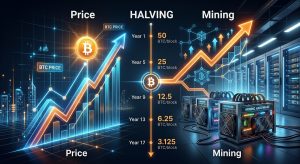
Bitcoin’s supply is capped at 21 million coins. To enforce that cap, the protocol includes a halving mechanism. Every 210,000 blocks, roughly every four years, the block reward miners receive gets cut in half.
Here is how that has played out since Bitcoin launched:
- 2009: Block reward starts at 50 BTC per block
- 2012 (first halving): Block reward drops to 25 BTC
- 2016 (second halving): Block reward drops to 12.5 BTC
- 2020 (third halving): Block reward drops to 6.25 BTC
- 2024 (fourth halving): Block reward drops to 3.125 BTC
Each halving squeezes mining margins. If Bitcoin’s price does not rise to compensate, some miners find operations unprofitable and shut down their machines. This temporarily reduces the total hashrate until difficulty adjusts downward, making things more viable for the miners who remain.
The triangle every serious miner watches is: electricity cost, Bitcoin’s market price, and current difficulty. Energy costs tend to be fixed or contractual. Mining revenue fluctuates with Bitcoin’s price. Difficulty adjusts based on how many miners are competing at any given time.
A miner paying ten cents per kilowatt-hour operates in a very different world from one paying twenty cents. Geography matters enormously. Countries with abundant renewable energy, subsidized electricity, or cool climates that cut cooling costs have attracted large shares of global mining activity for exactly this reason.
The Backbone That Holds Every Bitcoin Transaction Together
Mining is not a side feature of Bitcoin. It is the backbone. Every transaction you send, every wallet balance you check, every block added to the chain depends on miners doing their work reliably and honestly.
The economics have tightened since the early days. Competition is fiercer. Rewards are smaller in Bitcoin terms. Electricity costs can make or break an operation that would have been highly profitable a decade ago. But mining still functions exactly as intended. Blocks keep arriving roughly every ten minutes. The blockchain remains extraordinarily difficult to alter.
As block rewards continue to shrink with each halving, transaction fees will take on a growing role in compensating miners. Bitcoin’s long-term security model depends on those fees becoming substantial enough to keep miners motivated even after the last Bitcoin is mined, a milestone that will not arrive until around the year 2140.
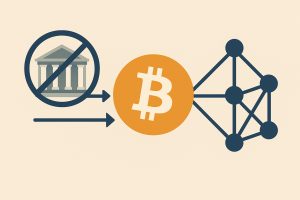
For newcomers, the core takeaway is this: Bitcoin does not rely on a bank, a government, or a company to verify transactions. It relies on miners competing honestly, burning real-world resources to earn real rewards. That competitive process is what makes the ledger trustworthy without needing anyone in charge of it. And that is exactly why mining still matters.





No Responses